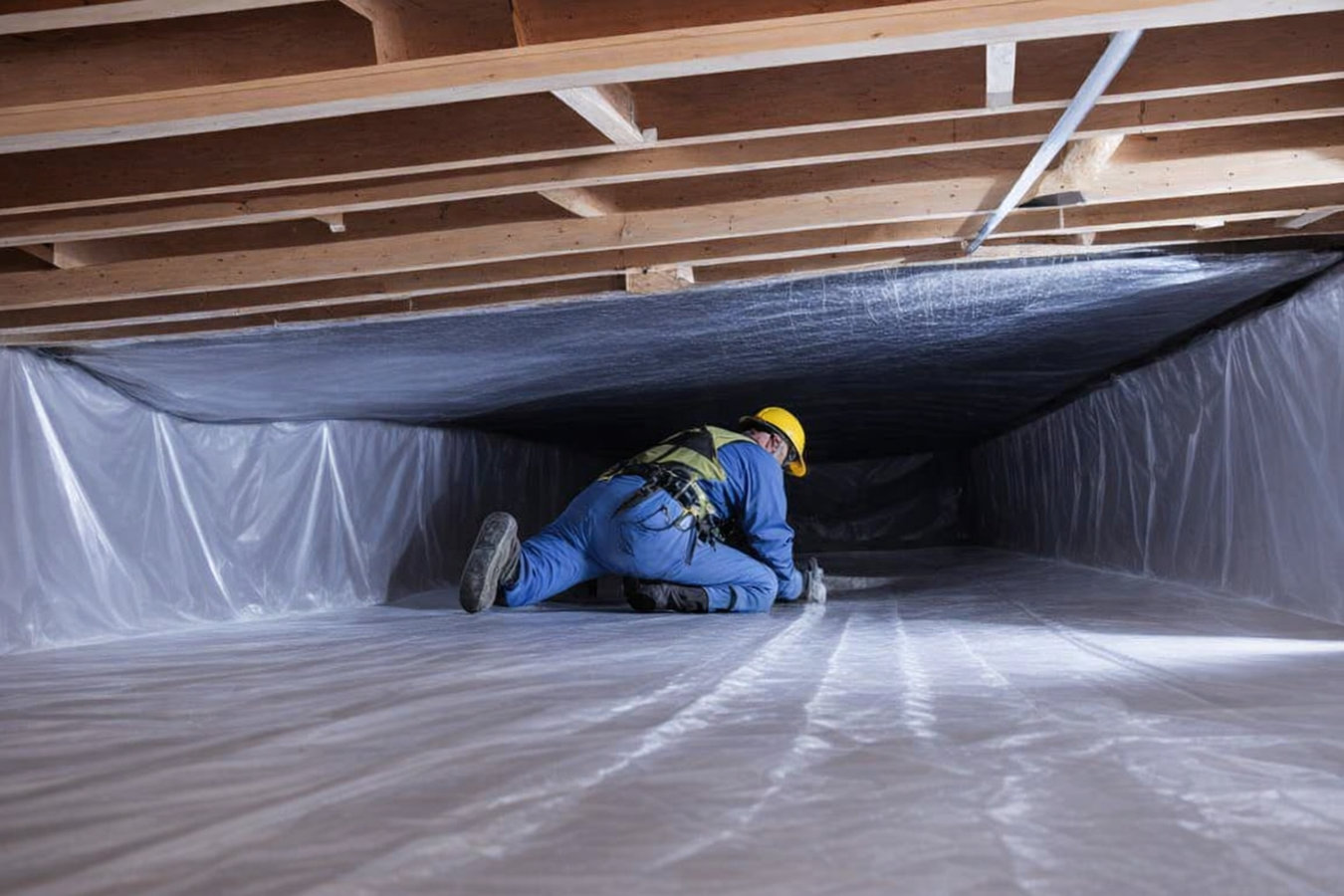
Lifting tile, musty smells, and damp floors are signs your slab is letting moisture in. We stop it at the source with proper vapor barrier installation - most jobs done in a single day.
Vapor barrier installation in San Luis blocks moisture from moving through your concrete slab or crawl space floor and into your home - most jobs on an average-sized home are completed in one day, with no need to vacate the property and no curing or waiting period after the work is done.
San Luis is a slab-on-grade city. Nearly all homes here are built directly on concrete, which means moisture control happens at the slab level rather than in a traditional crawl space. That is a different process than what most online guides describe, and it requires a contractor who works on this type of foundation regularly. The Colorado River corridor runs through this part of Yuma County, and parts of San Luis sit above a water table that is higher than you might expect in a desert environment. Add the monsoon season - which runs from mid-June through September and can saturate the ground fast - and the result is that slab moisture is a real and common problem for homeowners here. A significant portion of San Luis homes were also built in the 1980s through early 2000s, when under-slab moisture protection standards were less strict than they are today.
For homes where moisture is also entering through the attic or through air leaks, pairing this work with attic air sealing gives you a more complete improvement. If your home has a raised crawl space rather than a concrete slab, the crawl space vapor barrier page covers the options that apply to that foundation type.
If you press your hand to a tile floor and it feels cool and slightly damp even when it has not been mopped, moisture is likely coming up through the slab from below. In San Luis, this is especially common in homes near the river corridor where the ground holds more water. Tiles popping up at the edges or vinyl that is bubbling are telling you the same thing.
A smell that appears in summer and fades in fall is one of the clearest signs that seasonal moisture is entering your home from below. San Luis monsoon storms can saturate the ground quickly, and if your slab is not well-protected, that moisture moves upward. If the smell is strongest near the floor or in rooms with tile, the source is almost certainly under the slab.
Water that wicks up through a slab does not stop at the floor - it travels into baseboards, drywall, and framing over time. If you see discoloration along the bottom of your walls, or if pressing on a baseboard feels soft rather than firm, moisture has already been working its way in for a while. Catching this early saves you from a much more expensive repair later.
If you recently bought your home or had an inspection done and the inspector noted moisture concerns or inadequate vapor protection, that is a direct recommendation to act. Many San Luis homes built before the mid-2000s were constructed with minimal under-slab moisture protection, and an inspection finding like this is worth taking seriously rather than setting aside.
The right approach depends on your foundation type and what your home is showing you. For new construction and additions, a vapor barrier goes under the concrete before the slab is poured - this is the most complete form of protection and the easiest to install correctly because there is no existing material to work around. For existing slab-on-grade homes, a surface-applied moisture barrier product can be applied directly to the concrete before new flooring goes down, which is often done during a renovation or flooring replacement. A well-installed barrier lies flat, overlaps at seams by at least a foot, and is taped or sealed so moisture cannot sneak through any gaps - those details are what separate a job that lasts 20 years from one that fails in five.
For homes on raised foundations rather than slabs, we install heavy-duty polyethylene sheeting in the crawl space - a process covered in detail on our crawl space vapor barrier page. For homeowners who want to address both moisture from below and air infiltration from above in the same project, we can scope this work alongside attic air sealing - a combination that tackles two of the most common comfort and efficiency problems in San Luis homes at the same time.
Installed beneath new concrete pours during construction or additions - the most complete moisture protection for slab-on-grade homes that are the norm in San Luis.
Applied directly to an existing concrete slab before new flooring goes down - addresses moisture wicking in older homes without the need to break up the existing slab.
Heavy-duty polyethylene sheeting for homes on raised foundations - stops ground moisture from rising into floor joists and subfloor framing.
Combines vapor barrier with attic air sealing in a single scope of work - addresses moisture from below and air infiltration from above for a more complete home performance improvement.
San Luis has two things working against its homeowners when it comes to slab moisture. First, parts of the city sit in the Colorado River corridor, where the water table is higher than you would expect from a desert location. When the water table is close to the surface, moisture wicks upward through concrete slabs over time - a slow process that shows up as damp floors, lifted tile edges, and musty smells that homeowners often attribute to something else for years before realizing the source. Homeowners in neighboring Somerton face the same water table and soil conditions.
Second, San Luis sits directly adjacent to San Luis Rio Colorado, Sonora, and the two cities share a climate zone that can produce higher relative humidity than inland Yuma during certain seasons. Combined with the monsoon season that runs mid-June through September, this means slab moisture is not just a wet-month problem - it is a year-round concern in this part of the border region. Homeowners in Yuma also deal with these conditions, though homes farther from the river corridor tend to have slightly less ground moisture pressure. If your home was built before the mid-2000s and you have never had the moisture protection checked, the odds are reasonable that the original under-slab protection - if any - has degraded. An in-person assessment is the only reliable way to know.
We ask about your home's age, flooring type, and what symptoms you have noticed. You do not need all the answers - describe what you have seen or smelled and we guide the conversation from there. We reply within one business day.
We visit your home to check the slab, look at any accessible areas under the home, and assess where moisture is entering or likely to enter. In San Luis, we also ask about your home age and seasonal changes in moisture - that context helps us recommend the right solution for your specific situation. You get a written estimate before any work is agreed to.
The crew arrives with materials and tools for your specific job. For a slab-on-grade home, this typically involves surface preparation, laying the barrier material, sealing all seams and edges, and addressing any penetrations like pipes or posts. Most homeowners stay home during the job without any issue.
Before we leave, we walk you through the finished installation - show you where seams were sealed, how the material is secured at the edges, and what to watch for going forward. A quality installation comes with a workmanship warranty, and we are willing to come back and assess if symptoms persist.
Free on-site visit, written estimate, no obligation. Most jobs completed in one day.
(928) 296-5342We know which San Luis and Yuma County projects require a building permit before work begins, and we handle that paperwork ourselves - you do not have to navigate the process. Every job starts with a free written estimate so you know the scope and price before signing anything.
San Luis has grown to more than 35,000 people, and we have worked on homes throughout the city - from older neighborhoods near the Port of Entry to newer subdivisions built in the 2000s and 2010s. We understand the local construction patterns, slab conditions, and how monsoon season affects different parts of the city.
Nearly all San Luis homes are built on concrete slabs rather than raised foundations. Most online vapor barrier guides are written for crawl space homes, which is a different process. We work on slab-on-grade homes every week and know the specific approaches that work for the foundation type and soil conditions in this area.
You receive a written estimate covering exactly what gets done, which areas are treated, what materials are used, and the total cost - including permit fees if applicable. No surprises on installation day, and no pressure to sign before you are ready.
We assess your home in person, explain what we find in plain language, and give you a written estimate before any work starts. There is no pressure to book on the spot - we want you to feel confident in the decision, not rushed into it.
For independent guidance on moisture control standards, the U.S. Department of Energy moisture control resources and the Building Science Corporation vapor barrier guide are both reliable references.
Seals the gaps in your attic that let conditioned air escape and hot outside air in - pairs well with vapor barrier work to address both moisture and energy loss in a single improvement plan.
Learn moreCovers moisture protection specifically for raised-foundation homes - read this if your home has a crawl space rather than a concrete slab.
Learn moreMonsoon season does not wait - protect your slab before the ground gets saturated again. Call or request a free estimate now.